
Vessel Sealing Generator vs. Bipolar Generator — What's the Real Difference?
Both use bipolar RF energy — but a vessel sealing generator adds real-time impedance feedback, controlled jaw pressure, and automated seal cycles. Here’s what truly separates them — and why it matters for your OR.
LigaSure™, Valleylab™, and Force Triad™ are trademarks of Medtronic; Harmonic™ is a trademark of Ethicon; THUNDERBEAT™ is a trademark of Olympus. This article is for educational purposes and does not constitute medical advice. H Group Med is not affiliated with any of these companies.
In the Operating Room, Two “Bipolar” Generators Are Often Confused
Surgeons rely on electrosurgical energy for cutting, coagulation, and hemostasis. Two generator categories often cause confusion: the vessel sealing generator (sometimes called an advanced bipolar vessel sealer) and the conventional bipolar generator.
On the surface, they look similar — both use bipolar radiofrequency (RF) energy, both avoid the patient grounding pad required by monopolar systems, and both are staples of modern minimally invasive surgery.
But the technology inside these generators — and the surgical outcomes they deliver — are fundamentally different. Understanding the distinction matters for distributors specifying OR equipment, hospitals evaluating capital spend, and surgeons choosing instruments for specific procedures.
The Short Answer
A bipolar generator delivers RF energy between two electrodes (typically on forceps tips) to coagulate tissue. Activation time is controlled by the surgeon, and the energy output is generally constant during use.
A vessel sealing generator is a specialized type of bipolar generator that adds three critical capabilities:
- Real-time tissue impedance feedback — monitoring tissue changes hundreds of thousands of times per second.
- Controlled mechanical jaw pressure — typically 5,000–7,000 kPa — that works together with the energy.
- Automated seal cycle — the generator detects when the seal is complete and stops energy delivery automatically.
The result: a vessel sealing generator creates a permanent fusion seal of collagen and elastin in vessel walls, capable of withstanding pressures up to 3× normal systolic blood pressure (~500 mmHg burst pressure). A conventional bipolar generator only coagulates tissue — it does not reliably fuse vessel walls.
How Each Generator Works
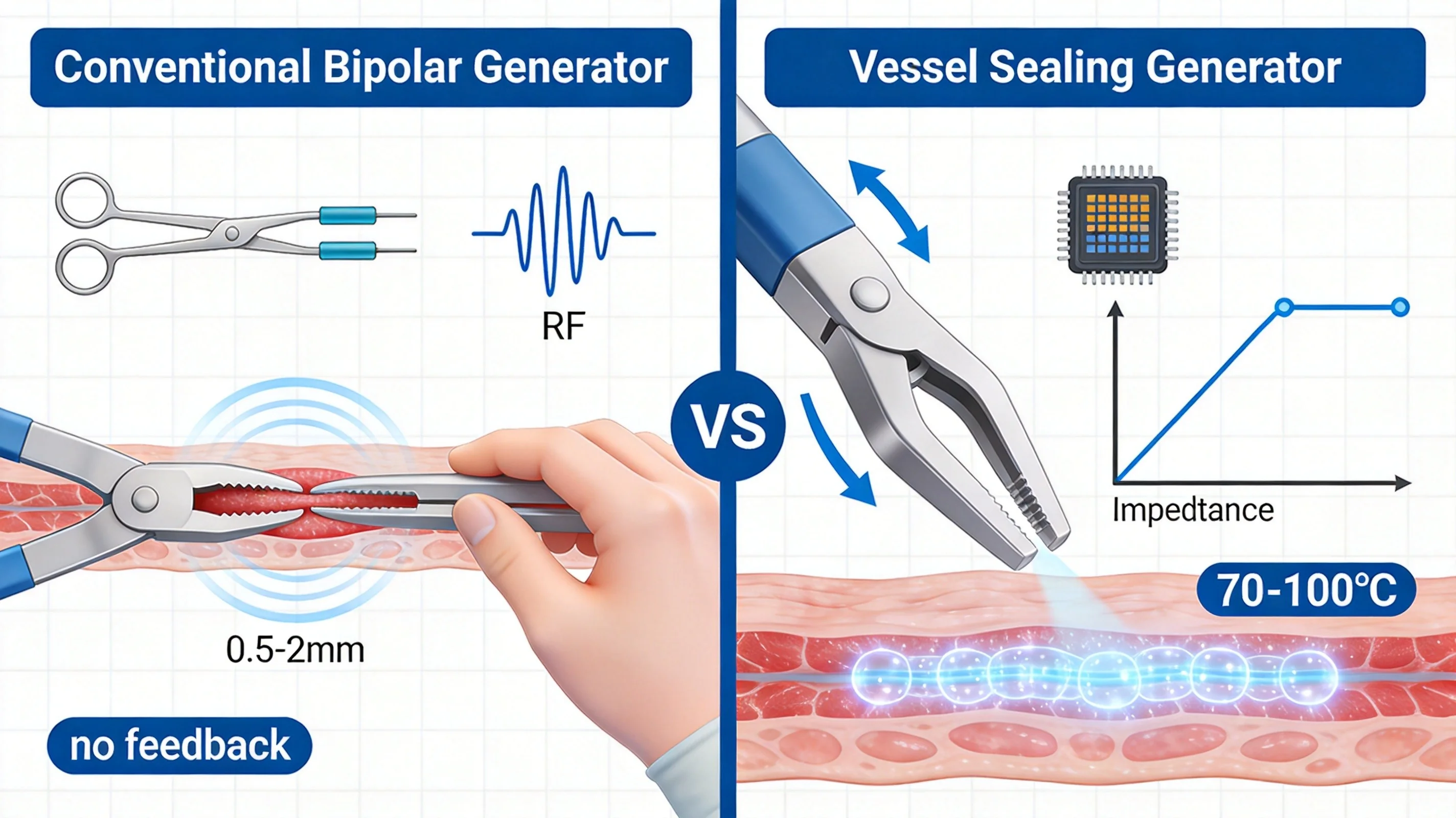
Conventional Bipolar Generator
Working principle:
- High-frequency alternating current (typically 300 kHz – 1 MHz) flows only between the two tips of a forceps.
- The current passes through the small piece of tissue grasped between the jaws.
- Heat generated by tissue resistance denatures proteins and coagulates blood.
- No return electrode (grounding pad) is needed.
| Parameter | Typical Range |
|---|---|
| Power output | 15–80 W |
| Peak voltage | < 500 V |
| Thermal spread | 0.5–2.0 mm |
| Activation | Surgeon-controlled (manual timing) |
| Vessel sealing capacity | ~2–3 mm diameter |
| Tissue feedback | None (basic models) |
Limitations: Activation duration is determined by the surgeon’s visual assessment — undercoagulation risks bleeding; overcoagulation risks charring and tissue sticking. Thermal energy can spread to surrounding tissue if activation is prolonged. Cannot reliably seal vessels larger than 2–3 mm. No integrated cutting mechanism — surgeon must coagulate, then switch to scissors.
Vessel Sealing Generator
Working principle:
- Also uses bipolar RF energy (typically 300–500 kHz), but at lower voltage and higher current than conventional bipolar.
- Combines RF energy with high mechanical jaw pressure.
- A microprocessor monitors tissue impedance in real time (up to 434,000 times per second in advanced systems like Medtronic’s TissueFect™).
- As tissue dehydrates and collagen denatures, impedance rises — the generator detects this rise and automatically terminates the cycle.
- The combination of heat + pressure permanently fuses collagen and elastin in the vessel wall, forming a translucent “seal zone.”
| Parameter | Typical Range |
|---|---|
| Power output | 100–300 W (with feedback control) |
| Peak voltage | Lower than conventional bipolar |
| Thermal spread | 1.0–2.0 mm |
| Activation | Automated seal cycle (2–6 seconds) |
| Vessel sealing capacity | Up to 7 mm diameter |
| Burst pressure of seal | > 500 mmHg (≈ 3× systolic BP) |
| Tissue feedback | Continuous impedance monitoring |
| Integrated cutting | Available on selected instruments |
Completion signal: When the seal is complete, the generator provides an audible/visual indication and stops energy delivery — removing guesswork from the surgeon’s workflow.
The Three Fundamental Differences
| # | Difference | Conventional Bipolar | Vessel Sealing |
|---|---|---|---|
| 1 | Energy control | Constant output; surgeon times activation | Feedback-controlled; auto-terminates based on tissue impedance |
| 2 | Tissue effect | Coagulation (protein denaturation) | Permanent collagen + elastin fusion (vessel wall welding) |
| 3 | Max vessel size | ~2–3 mm | Up to 7 mm (renal, splenic, uterine arteries) |
Why #1 Matters: Consistency
A conventional bipolar’s outcome depends on the surgeon’s judgment of “when it looks done.” A vessel sealing generator uses a programmed algorithm — every seal cycle follows the same curve regardless of who activates it. This translates to reproducible seal quality across a procedure and across surgeons.
Why #2 Matters: Seal Strength
Coagulation stops bleeding temporarily. A fused seal is permanent — the tissue in the seal zone becomes a strong, translucent band that withstands physiological blood pressure long-term. This is why vessel sealing can replace sutures, clips, and ligatures on vascular pedicles.
Why #3 Matters: Clinical Scope
Being limited to 2–3 mm vessels means conventional bipolar is restricted to small-vessel hemostasis (capillaries, small branches). A vessel sealing generator that seals up to 7 mm vessels can handle major vascular pedicles in procedures like nephrectomy, hysterectomy, colectomy, and splenectomy.
Clinical Implications
Where Conventional Bipolar Shines
- Delicate neurosurgery and ophthalmic surgery — where minimal thermal spread is critical and vessels are tiny.
- Precision coagulation near nerves — the small thermal zone (0.5–1.5 mm) protects critical structures.
- Low-cost OR setups — a basic bipolar generator costs $1,500–$4,500 USD vs. $4,500–$12,000+ for a vessel sealing platform.
- Wet-field procedures — bipolar works in fluid where monopolar fails.
Where Vessel Sealing Generators Excel
- Major abdominal surgery — hysterectomy, colectomy, nephrectomy, splenectomy where 5–7 mm vessels must be controlled.
- Laparoscopic and robotic surgery — reduced instrument exchanges (seal + divide with one device).
- High-volume ORs — each seal cycle takes only 2–4 seconds; studies show 15–30 min reduction in anesthesia time per case.
- Procedures with multiple vascular pedicles — eliminating sutures/clips dramatically speeds workflow.
The Clinical Evidence
- Robotic partial nephrectomy study (2023–2025, 112 patients): vessel sealer group had significantly lower estimated blood loss (40 mL vs. 132.5 mL, p=0.037) compared to bipolar grasper.
- Systematic reviews of hysterectomy procedures: advanced bipolar vessel sealing shows reduced blood loss and shorter operative time vs. conventional techniques.
- Thyroid surgery meta-analysis: vessel sealing provides comparable outcomes to ultrasonic devices with advantages in specific steps.
The Broader Energy Device Landscape
It’s worth noting that vessel sealing and conventional bipolar are both part of a larger electrosurgical ecosystem:
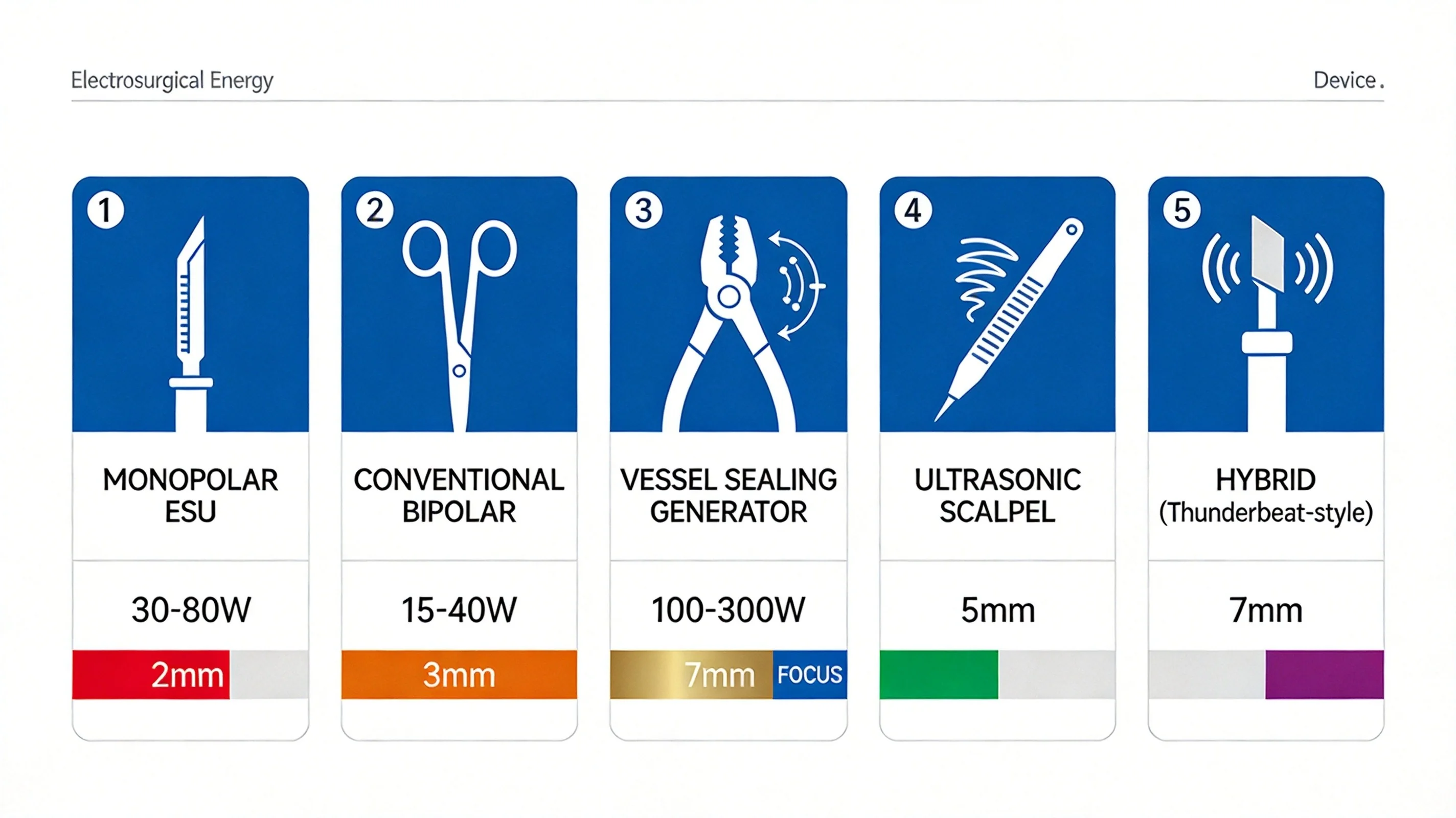
| Device | Energy Type | Primary Use | Max Vessel Size |
|---|---|---|---|
| Monopolar ESU | RF (300 kHz – 3 MHz) | Broad cutting + coagulation | ~2 mm |
| Conventional Bipolar | RF (300 kHz – 1 MHz) | Precision coagulation | ~2–3 mm |
| Vessel Sealing Generator | RF + pressure (feedback-controlled) | Permanent vessel fusion | Up to 7 mm |
| Ultrasonic Scalpel | Mechanical vibration (~55 kHz) | Cutting + coagulation | ~5 mm |
| Hybrid (e.g., Thunderbeat™) | Ultrasonic + bipolar | Both in one instrument | ~7 mm |
Modern ORs often combine multiple modalities — for example, using a vessel sealing generator for vascular pedicles and an ultrasonic scalpel for parenchymal dissection. The choice depends on procedure type, tissue characteristics, and surgeon preference.
What Distributors and Hospitals Should Evaluate
When procuring a vessel sealing generator platform, look beyond the unit price:
- Generator performance: Energy output range, impedance feedback frequency, seal-cycle indication reliability.
- Instrument compatibility: Only approved instruments should be used with the generator — cross-platform compatibility is not guaranteed.
- Total cost of ownership: Disposable handpieces vs. reusable options; seal cycle time (affects throughput); training requirements.
- Regulatory clearance: FDA 510(k), CE mark, ISO 13485 — verify the specific indications claimed.
- Seal burst pressure data: Published validation data, not just marketing claims.
- Compatibility with existing platforms: Many vessel sealing generators connect via cable adapter kits to existing energy hosts (e.g., compatible with Medtronic LigaSure™ LS10/FT10 hosts through adapter kits).
For context on how different energy platforms actually affect vessel sealing performance, see our companion article on how energy generator platforms affect burst pressure and thermal spread.
Frequently Asked Questions
Q: Can a vessel sealing generator replace a conventional bipolar generator?
Not entirely. Vessel sealing generators are optimized for larger-vessel sealing. For delicate procedures (neurosurgery, ophthalmic, close-to-nerve work), conventional bipolar’s smaller thermal footprint is still preferred. Many ORs keep both platforms.
Q: Is LigaSure™ the only vessel sealing system?
No. LigaSure™ is Medtronic’s trademarked vessel sealing technology, but multiple manufacturers offer advanced bipolar vessel sealing systems with similar core functionality (impedance feedback, mechanical pressure, automated cycles). Generic terms like “advanced bipolar vessel sealing system” should be used unless referring specifically to the branded technology.
Q: Does a vessel sealing generator use ultrasonic energy?
No. Vessel sealing uses bipolar RF energy combined with mechanical pressure. Ultrasonic scalpels use piezoelectric vibration (~55 kHz) to generate frictional heat — a different physical principle entirely.
Q: What vessel sizes can a vessel sealing generator handle?
Most platforms are validated for vessels up to 7 mm in diameter (arteries, veins, lymphatics, tissue bundles). They are not intended for major named vessels like the aorta.
Q: Why is the seal so strong?
The combination of controlled RF energy and high mechanical pressure denatures collagen and elastin in the vessel wall. As these proteins reorganize and cool, they form a permanent fused structure — like spot-welding the vessel wall shut — with burst pressure typically exceeding 500 mmHg.
Conclusion
Vessel sealing generators and conventional bipolar generators share a common foundation — bipolar RF energy — but diverge significantly in capability. The conventional bipolar is a precise, low-cost coagulation tool ideal for small-vessel hemostasis and delicate work. The vessel sealing generator is a feedback-controlled, pressure-assisted platform that creates permanent, high-strength vessel fusion seals up to 7 mm in diameter.
For hospitals and distributors evaluating electrosurgical energy platforms, the choice is rarely either/or. Modern surgical practice benefits from both: conventional bipolar for precision tasks and vessel sealing for vascular control in major procedures. Understanding the technical distinctions ensures the right platform is specified for each clinical application.
At H Group Med, our vessel sealer system follows the core vessel-sealing principles described above — closed-loop impedance feedback, controlled jaw pressure, and automated seal cycles — and is designed to connect via cable adapter kit to major energy platforms including Medtronic LigaSure™ LS10/FT10 hosts. For burst-pressure data or technical documentation, contact our team.
LigaSure™, Valleylab™, and Force Triad™ are trademarks of Medtronic. Harmonic™ is a trademark of Ethicon. THUNDERBEAT™ is a trademark of Olympus. H Group Med is not affiliated with, endorsed by, or sponsored by any of these companies. This article is for educational purposes only and does not constitute medical advice.